
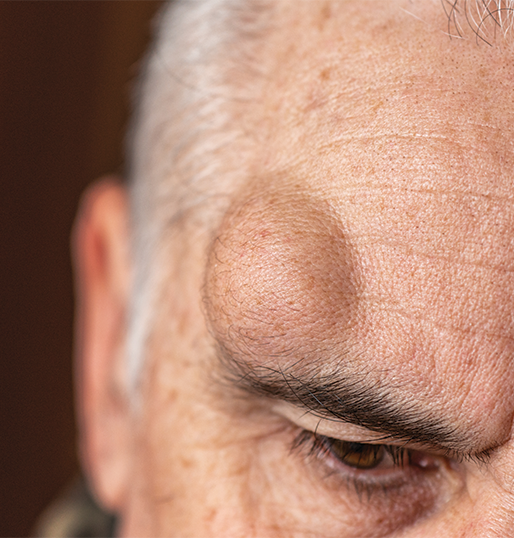

Cysts and lipomas are common, benign (non-cancerous) growths that most often develop in adulthood. While they are not dangerous, they can become bothersome over time, either cosmetically or due to discomfort, prompting many patients to seek evaluation or removal.
Lipomas are soft growths composed of fatty tissue that form just beneath the skin. They most commonly appear between the ages of 40 and 60 and may occur as a single growth or multiple throughout a lifetime. Lipomas often run in families. These growths tend to enlarge slowly and are usually painless, though they may become uncomfortable if located in areas prone to pressure or frequent contact, such as the forearms. The skin overlying a lipoma typically appears normal, while the growth itself feels smooth and rubbery beneath the surface.
Epidermoid cysts develop within a hair follicle and gradually fill with keratin (dead skin cells) and natural skin oils. In areas without hair, they may form after skin trauma or improper healing. They are most commonly seen in middle-aged adults, with men affected more often than women. The overlying skin may appear normal, though some cysts have a visible central opening (“punctum”) containing dark debris.
Pilar cysts arise from hair follicles on the scalp and are most frequently seen in middle-aged women. These cysts often run in families and resemble epidermoid cysts, but typically do not have a central punctum. When pilar cysts grow, they can become tender and interfere with daily activities such as shampooing or brushing.

Of people will develop an epidermoid cyst at some point in their lifetime

Lipomas — Are the most common benign soft-tissue growth, affecting 1 in 100 people

Most cysts and lipomas are benign but should be evaluated to rule out malignancy

In-office removal is quick, effective, and leaves minimal scarring
Cysts and lipomas are usually diagnosed clinically through a careful history and physical examination. If the growth is not painful or cosmetically concerning, patients can be reassured that these lesions are benign and do not turn into skin cancer.
Occasionally, cysts may become inflamed. In these cases, treatment may include injected steroids and, when appropriate, oral antibiotics. Patients are strongly advised not to squeeze or drain cysts at home, as this can increase inflammation, infection, and scarring.
For patients who wish to have a cyst or lipoma removed, surgical excision is a safe and effective option. Most growths can be removed comfortably in the office using local anesthesia. All excised tissue is sent for pathological evaluation following the procedure.

“Dr. Spring was just fabulous to deal with. She listened intently and had a great personality to boot. I’m almost 82 years old, and my initial visit with her was one of the best experiences I have EVER had with any physician. I feel privileged to have her as my doctor, and I highly recommend her!!!”
“Dr. Spring was amazing. She explained everything thoroughly and respected my concerns.”
“Dr. Spring and her staff were upbeat, attentive, and caring. They saw my anxiety prior to my procedure and took an extra moment to talk through it with me, which made me feel like they care about me as a whole person. I’ve never felt anxious prior to treatment before so this extra step really hit home.”
“Kudos to Dr. Spring. She has the Eye of an Eagle, the Heart of a Lion, yet the Hand of a Woman! Best surgeon ever!”
“Baillie made me feel very comfortable and she was very thorough. She has a personality that makes one feel comfortable about being in a doctor’s office.”
“I was very impressed with Baillie Steele. She is knowledgeable and took the time to listen to me.”
“Baillie has brought personal care to a higher level. Her thoroughness and caring are exemplary.”


At Capital Skin & Laser, we understand the importance of clarity when evaluating new skin lumps or bumps. If you have a growth you believe may be a cyst or lipoma, our experienced team is happy to provide a thoughtful evaluation and clear guidance.
For patients considering removal, our physician-led practice offers personalized consultation, detailed discussion of expectations, and attentive post-procedure care. Dr. Leah Spring brings advanced surgical expertise from her surgical and cosmetic dermatologic fellowship training, allowing her to skillfully excise growths of varying sizes while prioritizing beautiful, refined outcomes.




If you have noticed a new or changing lump beneath your skin, schedule a consultation at Capital Skin & Laser. During your visit, we will perform a thorough evaluation to determine the nature of the growth and discuss whether observation or removal is the most appropriate next step.
For patients considering treatment, we will review the procedure in detail, including technique, expected healing, and what to anticipate during recovery. Our goal is to provide clarity, reassurance, and a carefully considered plan, whether that means monitoring a benign lesion or proceeding with precise, in-office removal.
"*" indicates required fields
We're excited to welcome you to Capital Skin & Laser. You can now book your appointment online, anytime, from anywhere, and be among the first to experience our care.
Book Now