
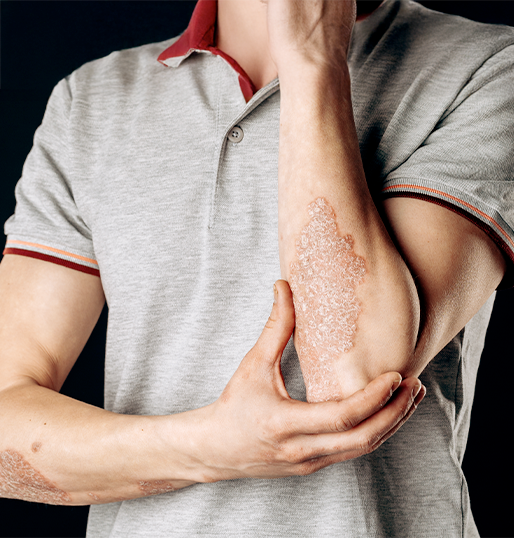

Psoriasis is a chronic, immune-mediated disease that causes red, scaly areas called plaques, often with an overlying silver scale. These plaques most commonly appear on the scalp, trunk, elbows, and knees, but can affect the entire body. Many patients often notice changes in their fingernails or toenails, such as pitting, thickening, or separation.
Although psoriasis can occur in childhood, it most commonly begins between the ages of 15 and 25 or 50 and 60. Many factors, including genetics, infections, stressful life events, and certain medications, influence the development of psoriasis.
Symptoms vary widely. Some patients experience mild itching, while others develop intense itch, skin thickening from chronic scratching, or painful cracking and bleeding of plaques. Even after plaques resolve, changes in skin color may remain and can take months to fade.
Psoriasis is more than just a skin condition; it is a systemic inflammatory disease, with the skin serving as one of its visible manifestations. In some patients, inflammation extends to the joints, leading to swelling, stiffness, and pain. Psoriasis is also associated with metabolic syndrome (obesity, diabetes, and high blood pressure), and an increased risk of cardiovascular disease, including heart attack and stroke.

Americans live with psoriasis, a chronic autoimmune skin condition

Of psoriasis patients report a significant impact on their daily quality of life

Psoriasis causes skin cells to turn over up to 10× faster than normal

Today’s treatments can achieve clear or almost-clear skin for most patients
Psoriasis is diagnosed through a discussion of symptoms and medical history, along with a skin examination. In certain cases, a skin biopsy may be recommended to confirm the diagnosis or rule out other conditions.
The location and extent of skin involvement, age of onset, presence of nail or joint disease, and symptoms like itching help guide an individualized treatment plan.
Mild psoriasis is often well controlled with topical medications alone. For more moderate to severe disease, additional treatments such as light therapy, oral medications, or injectable biologic medications may be recommended. These advanced therapies are especially helpful for patients with extensive skin involvement or associated joint symptoms.
At Capital Skin & Laser in Columbia, South Carolina, our team is committed to improving both skin health and overall well-being for patients living with psoriasis. We have extensive experience managing topical, oral, and biologic therapies for all types and severities of psoriasis.
We recognize the physical, emotional, and social burden psoriasis can place on our patients and approach care with compassion. Your initial visit will include a comprehensive review of your medical history, general health, and prior treatments, as well as a skin examination. When appropriate, we may recommend a biopsy, laboratory testing, or coordination of care with other specialists such as rheumatologists.





“Dr. Spring was just fabulous to deal with. She listened intently and had a great personality to boot. I’m almost 82 years old, and my initial visit with her was one of the best experiences I have EVER had with any physician. I feel privileged to have her as my doctor, and I highly recommend her!!!”
“Dr. Spring was amazing. She explained everything thoroughly and respected my concerns.”
“Dr. Spring and her staff were upbeat, attentive, and caring. They saw my anxiety prior to my procedure and took an extra moment to talk through it with me, which made me feel like they care about me as a whole person. I’ve never felt anxious prior to treatment before so this extra step really hit home.”
“Kudos to Dr. Spring. She has the Eye of an Eagle, the Heart of a Lion, yet the Hand of a Woman! Best surgeon ever!”
“Baillie made me feel very comfortable and she was very thorough. She has a personality that makes one feel comfortable about being in a doctor’s office.”
“I was very impressed with Baillie Steele. She is knowledgeable and took the time to listen to me.”
“Baillie has brought personal care to a higher level. Her thoroughness and caring are exemplary.”


If you are experiencing persistent plaques, itching, or psoriasis-like symptoms, schedule a consultation at Capital Skin & Laser. During your visit, we will perform a thorough evaluation, review your medical history and prior treatments, and develop a personalized plan designed to improve skin symptoms while supporting your overall health. Our goal is to provide clear guidance, effective treatment options, and long-term management strategies to help you maintain control of your condition.
"*" indicates required fields
We're excited to welcome you to Capital Skin & Laser. You can now book your appointment online, anytime, from anywhere, and be among the first to experience our care.
Book Now